
Veiled Vows and Bargaining Blunders
Explaining Secret Alliances in International Politics

In the summer of 1914, German leadership decided to execute a bold strike into France, cutting through Belgium in an attempt to hook around French forces and strike directly at Paris. They adopted such an escalatory policy, in part, because they were fairly certain that Britain would not intervene. Tied down by troubles in Ireland and unwilling to clearly signal their intent, British officials allowed German leadership to convince itself that London was apathetic. This was, of course, not the case. Indeed, in the years before the war, British officials thought extensively about how best to approach a conflict with Germany. The War Office ran several wargames designed to refine British plans for rapidly mobilizing and reinforcing French forces on the continent, and the British and French General Staffs even secretly engaged in joint operational planning from 1906 onward. Britain had thought quite a bit about war with Germany, and it was not going to sit idly by while Belgian neutrality was violated. But its failure to clarify its position ex ante was disastrous, as it gave German leadership the false confidence needed to precipitate a war into which the UK was ensnared. Yet for all its failures, British foreign policy at the time is explicable: London did not have a formal military alliance with France prior to the war and wanted to retain foreign policy flexibility so as to continue to play the role of Europe’s offshore balancer.
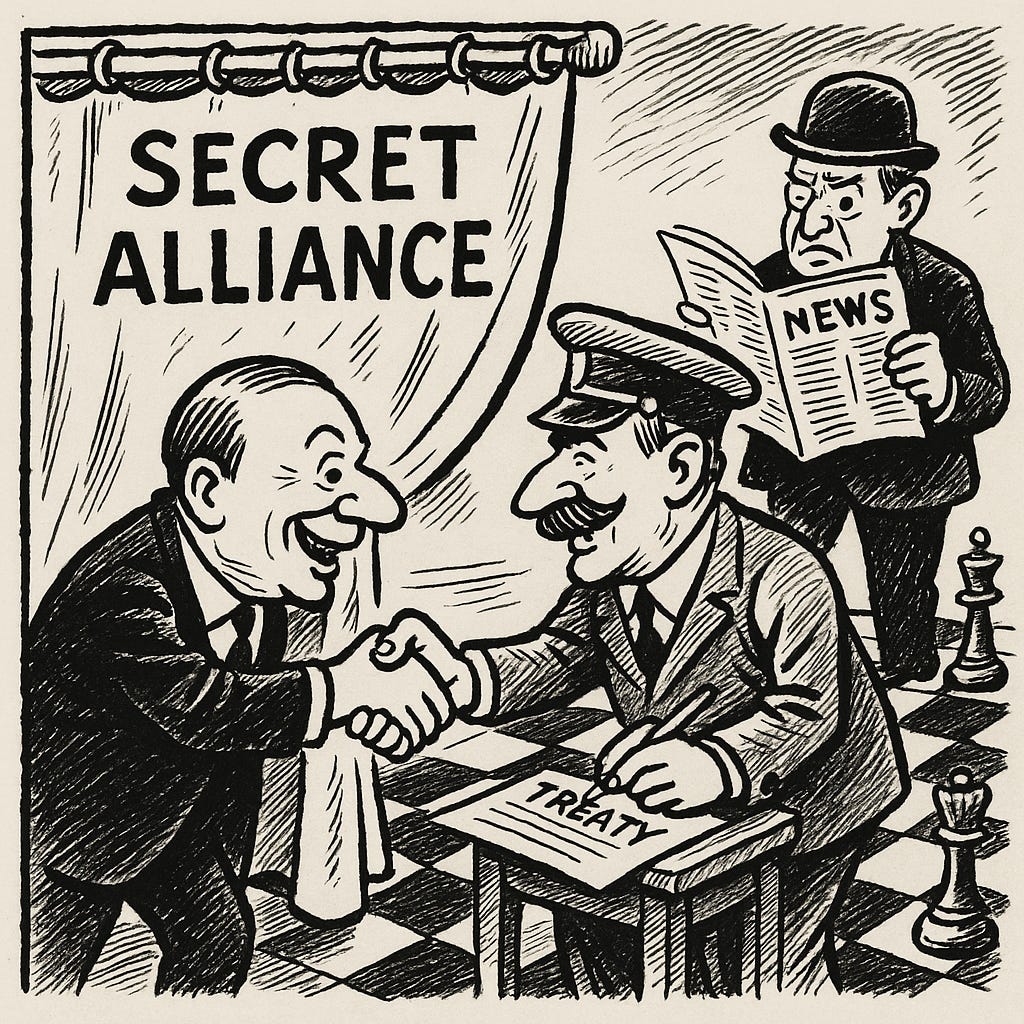
Far more puzzling are cases of secret alliance, where states do have formal treaty obligations to come to each other’s aid yet hide this agreement from third parties. Examples include the Austro-German Dual Alliance of 1879 and the 1873 Treaty of Defensive Alliance between Peru and Bolivia, but there are many more. What makes these secret alliances so bizarre is that they create all of the signaling challenges that came to haunt the British in the summer of 1914 without preserving any of the foreign policy flexibility. After all, these states have legally binding treaties that compel them to aid their allies, making it difficult for them to avoid entanglement. But because they opt to keep these obligations secret, they are limited in their ability to deter attacks on their (secret) ally.
In fact, secret alliances are much worse than the ambiguous alignment of the British in 1914 because they create a kind of moral hazard. As I’ve written about in previous posts, one of the most compelling explanations of war is the bargaining model advanced by rationalist scholars. In this telling, states should prefer to engage in peaceful bargaining to achieve a mutually beneficial outcome, as this allows both sides to avoid the often ruinous costs of war. Conflict only occurs when something inhibits peaceful bargaining, and one of the biggest inhibitors is asymmetric information. If one side obscures its relative power, the other side may underestimate the concessions it needs to make to avoid war. Secret alliances represent a highly asymmetric piece of information that drastically increases the likelihood of bargaining failures. The state that is part of a secret alliance is likely to demand greater concessions from bargaining partners because its strength is bolstered by that of its ally. Yet, because its alliance is secret, bargaining partners are likely to underestimate its strength and, by extension, its resolve. The bargaining partner suffers from false optimism, in other words, overestimating its leverage and rejecting bargains that it otherwise might accept, were it aware of the true balance of power. The outcome is obvious. Both countries stand firm, and the crisis spirals into war. A war into which the secret ally is likely to be dragged.
So why do secret alliances emerge? Two potential explanations have been advanced in the literature. First, as Bils and Smith argue, public alliances can signal foreign policy alignment between states. Sometimes this is desirable, but other times it can generate negative outcomes. For example, State A might be unsure of State B’s exact foreign policy preferences and geopolitical alignments. It may have concerns about State B’s exact intentions, but it is not yet certain that there exist serious diverging interests between itself and State B. But if State B then goes on to sign a formal, public alliance with another state that is not aligned with State A, this raises the probability in the mind of State A’s leaders that there are in fact diverging interests between their country and State B. In some situations, this new information may be enough to provoke a war. If State B fears that revealing its international alignment publicly is likely to stoke antagonism and invite attack, it will prefer to keep its alliance(s) secret.
Of course, this strategy of secrecy is of limited value. If State B is so worried about being attacked that it feels compelled to join a secret alliance, it is likely that State A would choose to strike regardless of whether it was provoked by State B publicizing its alliance. Thus, little is gained from secrecy. Similarly, if State A was already unlikely to attack, State B has little need to join a military alliance, secret or otherwise. Thus, we are only likely to observe secret alliances emerge when there is both uncertainty over particular countries’ foreign policy alignments and uncertainty over the likelihood of attack. When these conditions are met, secret alliances make sense, as they avoid creating a provocation while still providing insurance against potential attack. As Oldson notes of Romania’s secret alliance with Austria-Hungary and Germany against Russia, the aim was to “fashion an alliance system based on the desire to avoid war, and at the same time, to prepare for war.”
So states might choose secret alliances to manage potential adversaries. But they might also employ secret alliances to better manage their (secret) ally. As I’ve noted in several previous posts, asymmetric alliances tend to produce free riding. Knowing that allies will provide security leads many states to strategically underinvest in domestic military capabilities. After all, why spend on expensive military equipment if you can make another country’s taxpayers foot the bill? But the level of free riding is partly conditioned on the depth of alliance treaties. As Alley shows, deeper security commitments result in greater free riding. In this context, depth simply represents the extent of peacetime defense cooperation that an alliance treaty obliges its members to undertake—forward deployed forces, integrated command and control infrastructure, etc.—that make promises of wartime help more credible. Deeper treaties lower small members’ need to spend on their own forces because their partners have already sunk real resources and institutional effort into the relationship. Shallow treaties, with little or none of that built‑in cooperation, leave allies more exposed and often push them to spend more on defense.
Secret alliances must, by necessity, be relatively shallower than public alliances. This is because many of the steps that would deepen an alliance, such as the forward basing of soldiers on an ally’s territory, would also reveal the alliance’s existence. Thus, secrecy also serves as a means of keeping allies aligned on military investment contributions. Shallower alliances are not a free lunch. For one, they make ally reassurance especially difficult, which can potentially undermine the longevity of the alliance. Moreover, as Weitsman shows, deeply institutionalized alliances perform much better in conflicts against well defined threats (although they do worse against unexpected adversaries).
Secret alliances are, like most strategies in international politics, full of tradeoffs. They are far less effective at deterring conflict, create potential moral hazards, and are likely to be shorter lived and less militarily effective than public alliances. At the same time, in periods of great uncertainty, secret alliances can be a means of avoiding adversary provocation and safeguarding against allied shirking and free riding. Whether states pursue secret alliances is, therefore, a function of their priorities.
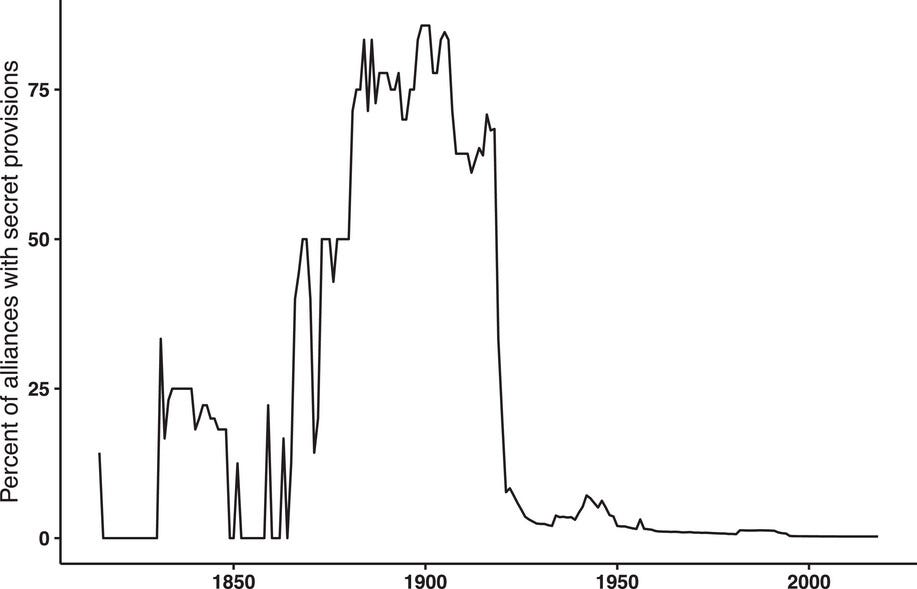
But there are good reasons to believe that secret alliances are mostly a thing of the past. For one, unlike in the late 19th and early 20th centuries, the international system today is highly polarized. It is pretty clear where most states stand on the core issues of geopolitical import. Thus, there is little value in attempting to avoid provocation by hiding one’s preferences; everyone already knows what they are. For the same reason, it is much harder to police allied free riding. Exactly because American interests in the Indo-Pacific are so well known, it is hard for Washington to credibly threaten to completely abandon its allies. Thus, these allies are incentivized to offload some of their military burdens onto the United States. Washington, moreover, has strong reasons to prefer a functional, well-integrated alliance to ensure that it would prevail in a conflict with Russia or with China. Since it cannot avoid provoking these adversaries, it needs to be especially ready to fight them. All of these pressures incentivize deep, public alliances. And this is exactly what we observe, as shown in Figure 1 (although we may be undercounting modern secret alliances given that they are secret).
Whether states’ aversion to secret alliances remains the case depends heavily on the future of the international system. For now, these kinds of defense agreements are mostly a curious historical phenomenon that make little sense from the modern vantage point. But if the international system evolves significantly from its current instantiation, these secret military agreements may increasingly come into vogue. If that occurs, we might need to look into the past to understand the future.